
jsheridan
Forum Replies Created
-
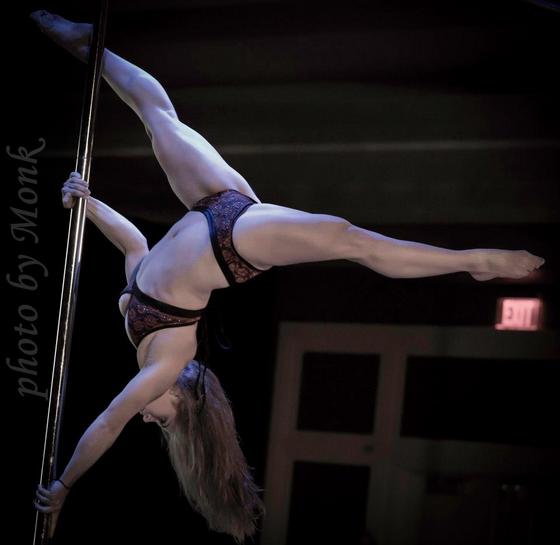
When I sit in straddle, I do this, then gently sit back slowly until my butt touches the floor, it helps me maintain my straddle.
-
What jenn said is possible. It is more of a sharp pain than a traditional muscle ache. However, assuming it is muscle stretching and rolling and massaging can help depending on injury. Mine gets super tight when I am doing a lot of cup grip handspring stuff. Or tg deadlift from cupid. Or handstands. Basically anything that works it really hard. Some stretches I do are sitting in childs pose and reach my hands to the opposite side of the sore muscle and the stretch where you put your hands on the pole about chest height and drop your head through your arms keeping your core tight so it does not become a back stretch. For rolling, I roll the other serratus muscle right under your armpits where your lat ties in. I also use a tennis ball to get in that groove under my shoulder blade for the anterior one. If you have someone who can massage it, if you take your arm and reach it behind you like backwards prayer hands it should chicken wing your shoulder blade and they can massage underneath and really get to it. It makes me want to cry but feels so good. Let me know if you need more information!
-
So a few things that I have my students do. I dont know much about your tailbone issue, so I dont know if they would help. First, I have them set their hands BEFORE going back, since you do need to pass over your hands. This way, you are already on top of your hands and dont need to do the a portion of the slide, which prevents you from catching on your butt. Also, it may help if you can get your shoulders closer to the pole before sliding, so you are more vertical. It will change the angle of pressure, and make the slide more controlled so you can loosen your leg grip to put even less pressure. That may be a flexibility issue, I dont know much about your flexibility!
-
jsheridan
MemberJune 2, 2014 at 7:01 am in reply to: help with pancake straddle/lower back stretches?Sorry this took so long. Here is the video. You can see I pull my feet in line with my face, then my feet down, then holding my feet in place, I try to roll my spine flat. I have a good pancake, so my back is pretty much flat on the floor. Yours may not be until you get better at it. its all about holding your feet and trying to flatten your spine at the same time. It will take a lot of work to get it to completely flatten out. Also, I posted another of my favorite stretches, where you sit in your straddle, and lean forward as far as you can without touching the ground, keeping your quads really tight. Active flexibility it one of the best ways to gain flexibility.
-
Make sure your hips are square to the floor before you put the second leg on. If not you rip your thighs rotating rhem. As some who refused to do superman because I hated rhe pain, I now live in rhis move. Yes it gets better
-
Release the hand holding the leg to reach above you, bring the back leg around to the same side as the front leg, and you end up in cradle position, which is easy to get out of.
-
jsheridan
MemberMay 29, 2014 at 3:43 pm in reply to: help with pancake straddle/lower back stretches?Pancake stretches can help with your middle split, but are stretching slightly different muscles. I will film the video tomorrow! Are you looking more interested in your pancake or your middle split?
-
jsheridan
MemberMay 24, 2014 at 7:57 am in reply to: help with pancake straddle/lower back stretches?A few things:
1. When doing your pancake, use the pole in front of you to pull towards the floor, think of pulling your belly button down, not rounding your shoulders. Keep your knees towards the ceiling.
2. My favorite stretch is one from Alethea Austins flex cd. Lie on your back, hold ankles or knee, pull your feet in line with your head in a straddle, like a straddle plow-ish thing. Then holding your feet still, try to roll your hips to the floor, working to flatten your spine. Let me know if you need a video of this.
3. For back/hips, try figure-4 and pigeon stretches. You can also fold forward in a butterfly stretch or while sitting cross legged.
4. A pancake is NOT a precursor to a middle split. 🙂 Totally different muscles. I have an over-pancake but will never have a straddle (because of my natural hip construction). One of my students has a perfect middle split and no where near a pancake.
let me know if you need more details!
-
I am assuming you extended butterfly? The way I teach my students to handspring is from an extended butterfly, bring the back leg back to the pole, so you are in a pike with one ankle on either side. From here, you can take you ankles off an inch or two, and see if you can hold it. If not, put them back on. If you have super flexible shoulders, yes you need to be stronger to compensate. Really make sure you are pushing out of your shoulder like a handstand. Handstands are also a great way to build the shoulder strength 🙂 If you feel like your shoulder is giving out, its either not strong enough or you are not pushing enough. With flexible shoulders, if you push too soon or too hard, you can injure the joint/ligaments, which take an extremely long time to heal. Be careful with your shoulders.
-
1. Judges are subjective, dont compete if you will base your self worth on what they say. Different judges will give different results. If they provide feedback, take what can help you, leave the rest. The only saw you for about 3 minutes, so cant give perfect feedback about who you are as a poler.
2. Have fun, do your best, be proud of getting up there
3. No routine will ever go perfect. Just sell whatever happened as what was supposed to happen.
4. Use eye contact/body language etc to engage the audience, draw them in.
5. Dont publicly criticize the event if things went less than ideally. They put in a lot of hours, stuff happens. They should gladly take feedback if you want to give it, but dont blast their hard work on public forums like facebook.
6. Point your toes 🙂 -
You close the leg you opened so you are in a pike, reach the top hand back up (that would be behind your leg in a normal allegra), then flip your hips. If you still need a video, I can do one tomorrow.
-
Allegra->superman->however you want to get to your cupid
-
@HonieT There are several Certs that offer a special one for working with special populations. NSCA definitely does, and either NASM or ACSM do as well, possibly both at this point. If that is your preferred population, those would be good to explore. I think its really important to figure out where you want to go with it, then do research as to what fits your needs the best. Certs are expensive to get and maintain, so you want to get the most for your money and be sure it is worth it to you. I invest probably $1000 at minimum to maintain my certification (NSCA) every time I need to recertify.
-
Basically, it depends on the level of seriousness. Some certs are harder/more expensive to get and maintain. You are also usually paid more for these. If you are doing it for yourself/part time, you are probably better off with one of the less expensive and easier certs. They dont always pay off if you are doing a few hours a week. NSCA-CSCS is the hardest to get/maintain, but one of the most highly regarded by well educadated people. ACSM is similar, slightly easier to maintain but also very highly rated. ACSM is a little more A&P (probably better for nursing etc) while NSCA is more program development/exercise form/strength and conditioning based. NSCA is also a little more athlete based, but the same principles apply, just on a scaled down level for the average exerciser.
NASM is probably next, not quite as difficult to get or maintain, but still very good. Its a has more “personal trainer” info, such as client interaction and sales (the others have this as well). The A&P and Program structure for optimum results is a little less in depth than the others, but has all the info you need to be a successful trainer.
ACE is probably the most popular. It is easier to get and maintain (and less expensive), while being slightly less in depth. It definitely covers all the basics. Most places will accept ACE certs, unless they are a very fancy club with high standards. When hiring, I was hesitant of interviewing people with ACE certs. People who think being a trainer is cool without wanting to do work usually have ACE. That is not to say all people with ACE fit that category, but I always interviewed carefully to see where they fit. There are many good trainers with ACE certs.
AFAA does great group ex, their PT cert is lacking. Any “weekend cert” is not worth your time, unless for personal knowledge. The others are not as reputable.
I can answer any other questions as well, if I missed any you were wondering about!
-
As a personal trainer and a former health and wellness director who hired trainers I have a lot of input. What is your goal with the certification? Side job? personal development? Full time career? it varies greatly depending on what you want it for.
-
For photos, depending on where you are you can do service trades. Some places have photographers looking to update their portfolio and some are willing to trade for personal training time. If you post something on a photographers forum about trading, you may find someone.
-
As for music, gladiator type music or theme songs from certain moves/games work really well. Or ninja.
-
People like Smamantha star, Zoraya Judd are both power polers who dont do much dance. I dont either, but I work on it a lot and do a lot of no pole allowed freestyles. If you are performing for students, etc then it doesnt matter as much, but the public likes stage presence. Not dance ability, but the ability to draw them in with eye contact, etc. And yes it does take practice. Not months, but years. If you keep working, some day it will come! I have been working on mine for 2 years, and its not there yet but much better than it was.
-
I have the 4″ Mighty grip mat, and I highly recommend it! Not too expensive, but I thought it was better quality than the yoga direct. Granted, I have a studio so it needs to hold up more, but I love it. And it ships really fast for less than the others I have seen.
-
It also depends if you are an employee or IC. You can write off more as an IC.
-
From looking at the photos, your bottom leg seems to be on a different angle from the top. To go into it, the rotation comes from your shoulders/torso and your hips, but you keep your legs still. If your legs are changing angles, then you are trying to rotate by moving them. I hope that makes sense!
-
I do think seeing the doctor is a good plan! Many running shoes are corrective to some degree, ie they prevent pronation, etc. They do marginally change your gait. Some are neutral, but not many. If you have bad knees in that sense, it can translate into pain in other parts of the body because you are favoring one. When my knee was injured (kicked by a horse) I got severe plantar fascitis because I was trying to minimize the stress in my knees so it went into other joints. This is extremely common, esp with legs because they are long, so a small deviation in your knee results in extreme deviation at the next joint up or down. I think a doctor who specializes in it will be able to watch you move to see what the cause may actually be.
-
I have run about a dozen half marathons as well as one full. There are many potential causes, aside from the shoes that were discussed, and starting slow (ie if you just started poling and did 3 days of strengthening in a row, you could also hurt yourself), you mentioned you were intentionally compensating for your crooked gait. For some people, corrective shoes help because they are hitting the way you are “supposed” to. However, for me personally, I have crooked knees and run slightly crooked. If my shoes try to correct that, my feet/knees are in excruciating pain and I cant run for weeks. I am better in a mimalist shoe that lets my legs do what they naturally want to do. You say you go barefoot a lot, so if you are wearing a corrective shoe for the first time, you will be using muscles you are not used to and impacting your joints in a whole new way.
Also, what is your running surface? Concrete sidewalks are extremely hard and the impact can cause some pain. As can asphalt. Try running on a track or other softer surface for additional cushioning.
A last factor to consider is may just be running with poor form. You say this is your third run ever. Many people have poor running form that takes time to develop, so it might help to go to a specialist that can do a gait analysis. A running store (not a sporting goods store, but one specific for running) may be able to guide you. A local physical therapist may also be able to direct you to someone.
Hope that helps!
-
I Love the butterfly idea! Were they just stickers or was it something else? I just want to make sure they stay up!
-
Another similar tactic is to sit on the floor legs straight in front of you (like a pike, but sitting up straight) Then, contract your quads, trying to lifts your heel off the floor (NOT your entire leg, just your heels). Your knees should stay on the floor.