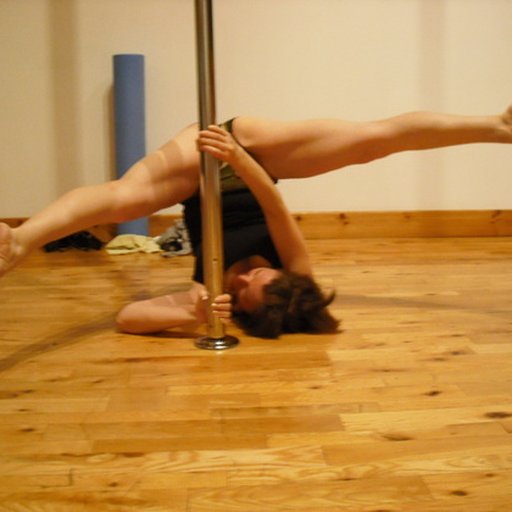
As fir the textured surface, I have an experiment for you. Get a nickel and a quarter. Now take the tip of your finger and press into the edge and move the coin down the length of your finger tip. Which one is easier and which one is harder? With a textured surface on the top of the texture is going to create friction. It is the same reason we wear minimal clothing...more skin = more grip. In much the same way, more surface = more grip. With a textured surface you only have a small portion that is coming in contact with your skin, the rest is an air pocket.
And me being the geek I am found a paper written regarding static friction and human plamar skin on grabrails. The abstract is kind of interesting:
The purpose of this study was to investigate the static friction properties between human palmar skin and five grabrail materials (chrome, stainless steel, power-coated steel, textured aluminium and knurled steel) for dry, wet and soapy hands. Thirty subjects (15 female, 15 male) participated in this study, their ages ranging from 19 to 45 years with a mean age of 28 years. The normal force, friction force, and coefficient of static friction were determined by measuring three-dimensional forces while slipping the palm of the hand over the surface of a grabrail. A repeated measures ANOVA indicated that gender, age, hand size and trial effect had no significant influence (p >0.05) on these results. The coefficient of friction (p <0.001) and friction force (p <0.001) were significantly lower when the hand was soapy than when it was dry or wet. The normal force applied when the hand was soapy was significantly greater (p <0.001) than when it was dry or wet. No significant difference was found between dry and wet hands. The two textured materials displayed superior friction properties when the hand was soapy, while the smooth materials performed best when the hand was dry.