Hi! And this question isn't stupid!
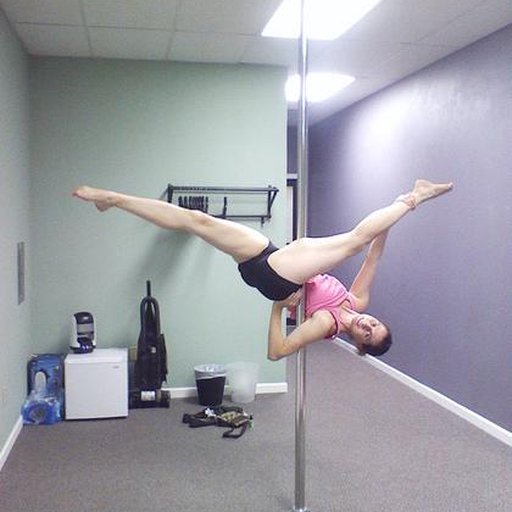
I think that in most holds requring two hands being placed on the pole, that the lower bracket is usually the one that can create turn or put the brakes on it. So if you're really wanting to stop the turning, being more mindful of how you place your lower hand is a good place to start. You may have to experiment to see which hand placement is best for you. Some people place their hand under one buttock or the other, and I've seen some people perform this move who almost look as though they are resting the thigh on the wrist. My preference for this move is to place my wrist right down the middle between my legs (hope that doesn't sound too graphic) because it allows me a little more room to lean back. This may depend a lot on each person's arm length and body type, so just play with the placement of the lower hand until you find the placement that you prefer! Also don't forget to really engage (without straining) the muscles of your wrist and forearm when you perform this move, as that will add stability to your grip and will also protect the joints along your wrist and elbow, which can be heavily taxed if a large amount of your body weight is being supported on it. Don't forget that most of the weight should be carried by your top bracket, and also remember to pull in with the abdominal muslces! 👍 All these things should help you stop or control any undesirable turning.
But on the other hand, I also want to ask you this. Why do you want to stop the turn? In my opinion, the ability to turn a static pose can be a very pretty addition to a pole dance and enable some beautiful transitions. So instead of stopping the natural turn that seems to be happening when you perform this move, you can start this pose from a slight side angle, so that when you turn in this pose it directs you to the angle you want to be facing (mirror, audience, instructor, classmates, etc.)! 🥂 Using natural turn this way on a static pole can really impress a viewer. Just watch any of Veena's videos on the static pole, or the static pole part of Felix's world championship winning routine for examples of how beautiful turning a pose on static pole can be.