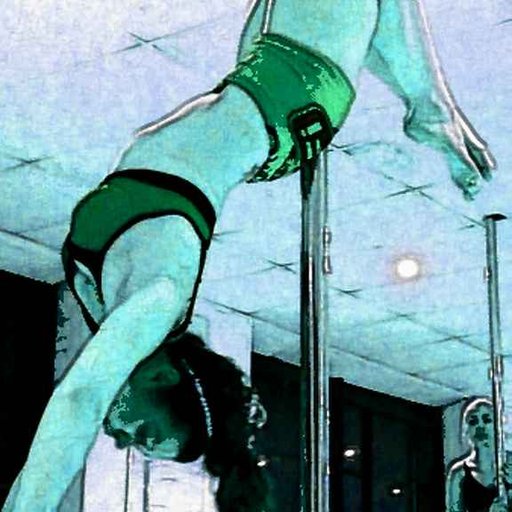
Pole Dancing is one of the best overall fitness regimens. One of the reasons I like it being a crazy fitness nut as well as just plain crazy. It can work both sides of the exercise world and often at the same time.
If you go on a walking, bicycle, Zumba or jumping jacks you are doing Aerobic exercise. That is the cardiovascular side. It requires oxygen from your lungs and pumped through your heart. The floor movements, dancing & general pole movement are aerobic. Your lungs or heart reach their limit way before any muscles do but doing aerobic exercise will increase cardio ability so you can dance longer.
If you are doing resistance exercise (lifting weights, push-ups, exercise bands) usually short periods past normal limits then it is anaerobic. It does not use large amounts of oxygen but the glucose in our bodies. The muscles are capable of only so much work at a time for a given resistance.
You might say do thirty bicep curl reps with a 5 pound weight but only do two with a 15 pound weight. Both to failure = Can't do anymore without injury. It is the failure that is important, because the more you use a muscle past its normal use is when you get the largest anaerobic benefit from the exercise. It is the muscle failure only and the heart & lungs should never be close to being exhausted. That is why when you hear about doing say a set of 25 reps of an exercise, it should be that for a given resistance/weight the 25 reps is your approximate failure. If you do 25 reps but can do many more reps than it is really an aerobic exercise. When you get to around the failure point you will start to feel a sort of burn in the muscle. That is a bi-product of lactic acid which is how your muscles get the energy. Nothing bad. Anaerobic exercise builds strength and lean muscle (Fast Twitch muscle fibers). It also can build muscular endurance (slow twitch). Everyone has both fast & slow twitch muscle fibers just not in the same percentage. Any kind of body weight resistance on a pole is an example of anaerobic and at some point you are using some muscles that weight lifters at the gym do not.
There are some exercises that sort of combine aerobic & anaerobic. Pole dancing is one of those! A Les Mills Body Pump class is another. Running short sprints, kayaking/canoeing. Even then, often there are various points where the failure point is reached first by one side or the other but you are exercising both. Pole Dancing switches between them especially in a long routine.
What Phoenix Hunter was experiencing is anaerobic. And obviously she is using the muscles to the failure point. That will work fantastic for her to increase the strength in those muscles.
Everyone has their own strengths, weaknesses & limits. Also in pole dancing, some people are exerting themselves more in their cardiovascular system. Some who are doing more moves that require supporting their body weight are putting the load on their muscle strength. There is an interview on youtube with a pole competitor where she said she created her routine switching between her legs & arms to give each muscle a chance to recover. Like anything else it is not one size fits all. When not doing pole it might be more beneficial for some to do aerobic exercise so they do not tire as quick. For others it might be doing resistance exercise (anaerobic) that will help their pole dancing the most. For a few people on here or in competitions, I am immensely jealous as they seem to have virtually no limits.
@I polekat I: Planks are an anaerobic. It is the core & back muscles that fail first. You are right that the shaking is good as you are using the muscles to failure. No Cheating! Planks and other exercise where there is no movement are isometric exercises. Isotonic are where there is movement like in pushups, squats, etc. and the muscle goes through contraction. A squat hold (for several seconds) is an isometric. So a complete of squatting down (Isotonic); holding squatted position for 15 seconds (isometric), and squatting back up (isotonic) goes through both. When I took physical therapist classes, they taught there are some situations especially recovery after surgery where isometric exercises are much, much better. Especially as most do not put undo stress on the joints.
Hope someone finds this useful....