

StudioVeena.com › Forums › Discussions › Hyperextension – Help needed
-
Hyperextension – Help needed
Posted by emotioncatcher on December 3, 2011 at 2:34 pmHey guys!
I hope some of you can give my a few tipps. I got a new student who can hyperextend there elbows. So it´s of course important to be very careful with her elbows.
I told her to always keep her arms slightly bend, because she doesn´t feel when her elbows are in natural position. it feels normal to her when they are hyperextended. So I could be sure, she doesn´t put too much pressure on them.
I know that some here have the same issue with the knees or other joints. Could some of you give me a few tipps on this. Is there anything I should know to prevent that she injures her arms?
I would also like some advice on strenghening exercices who could help her.
This is really important for me, so if tell me all you know about it!
Thanks in advance
emotioncatcher replied 14 years, 5 months ago 10 Members · 23 Replies -
23 Replies
-
I have hyperextended elbows myself. I've been a ballet dancer all my life, so I learned years ago how to correct them. I have a suprising number of students that have hyperextended elbows. With most students it's just a habit they have to break. Like you said, she has to be always aware of her elbows and keep them slighty bent. Eventually, her body and mind will get used to the postition and that will become her norm.
As far as strength training goes, I have found the best thing is straight arm planks. To begin with she may find them to be a lot harder than they usually are for her. My students with hyperextended elbows don't find this position that hard to hold until I make them do it correctly. They are used to supporting themselves by locking their elbow joints, if you make them slightly bend their elbows then their muscles have to work to hold them up. I've found that they are usually pretty weak when it comes to this position. I have them hold it in a push-up position and facing to the side on one arm.
-
Not an expert, but from my experience: A strong biceps will help against hyperextending. The function of the biceps is to bend the elbow – which is the opposite of extending.
A great way to demonstrate the concept is in a plank position like Amanda said. When I hyperextend the elbow in a plank it actually feels funny in the joint, as if my bones are carrying the weight. If I contract the biceps slightly the elbow goes straight and it feels much better and stronger. (But that's because I'm used to NOT hyperextending it)
And if her arms get stronger it should be easier for her to keep them from hyperextending. As a teacher you should pay attention in all moves where she uses a pushing motion with a straight arm (like split grip, or the top part of push ups …). She should concentrate on keeping her arm muscles active … just like we keep the shoulder muscles active 🙂
-
Not an expert, but a thought I had reading this on top of the excercises, if she is really having a hard time beaking the habit, (and if she is willing to do it) having her wear elbow pads like you do for rollerblading, ect would really make her aware of how straight/not striaght her elbows are. Sense the pads like to keep your arms slightly bent just off the way they are shaped and it will be a bit uncomfortable for her to have her elbows heyperextended.
-
thank you all for the great tipps. this really helps me a lot as I had no experiences with hyperflexible joints before!
I will definitly try the Plank when she comes next time. This will be a great exercise for her to get used to keeping her elbow bend while doing something which needs strenght. Then she hopefully will learn to do it during spins and holds, too.
I will also focus on doing more arm strenght exercises with her than i normally do with students to disburden her elbows. I think keeping the arms bend is already for a "normal" beginner student sometimes hard, but for her it might be extra hard, so I´m sure this will help her and she will need some extra strenght!
@solsticedark: I will ask her next time if she wants to break that habit. For pole dancing she won´t have the choice, but it would be great if she would do it in her complete life, because this would also make it easier for her to do it while being on the pole. The idea with the pads sounds great, although I´m not sure if she would feel comfortable with that. But maybe we could try something similiar strap of tape on the inside of her elbows, so that when she hyperextends her arms she will feel the tension and can correct it.
If I won´t find a item that can remind her, I´ll be her reminder. But it would be a lot better if she would notice it on her own.
Thanks again! Any additional information are still welcome of course!
-
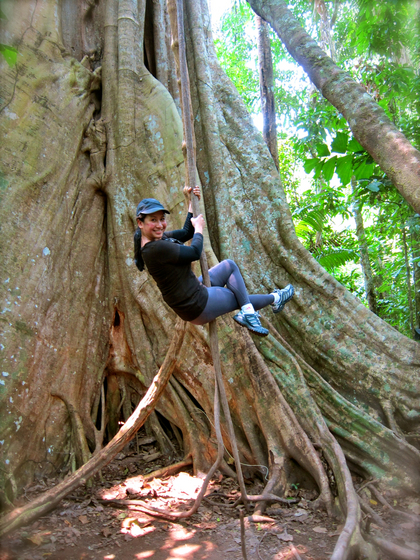
Hmm… I thought I'd give a student's perspective. Aside from doing pole, I am also a student in aerial silks, lyra and static trapeze and I have hyperextended elbows too. I've never done ballet so I cannot speak for that, but for pole and aerial, I don't see my hyperextended elbows as a "problem" or a "habit" that necessarily needs correction. I'm always open to my teachers' suggestions on form, but we all agree that I should lock my elbows if it makes me feel safer.
When I was learning how to hand stand on the pole, I was able to do it easily and securely with locked (but crooked) elbows. I kept being instructed to straighten them into "proper form", and I fell on my head each time. I was frustrated that I could no longer keep up with my class. I was quite annoyed for being repeatedly called out on my elbows. I felt it was unfair for my teacher to force me to lose that "brace". We couldn't figure out why, so she finally pulled me aside and watched me do it successfully my way, then observed how I fell each time I did it her way. We both had a lightbulb moment — it's not that I was weaker than everyone else in class (I can hold my chatarungas just as long), but it's that my body dynamics are just different. I figured out how to muscle my way into bending my elbows look straight after I learned to balance in a handstand with crooked elbows, but I still choose to do it with hyperextended because that's what feels right to me. We went through this again when I was learning the butterfly and the bow and arrow which both need locked arms. But these times my teacher worked with me to find the best way that fit my body instead of having me muscle my way into the appearance of straight arms.
My aerial teachers work together with me on my elbows too. There are certain moves in lyra where I intuitively grip the ring palm up or palm down differently from the way we're taught, and that's cool as long as I have tried both ways and I am confident that I am more stable doing my way. In fact, none of my aerial teachers ever saw my elbows as a problem… One of them even celebrates them and finds funky poses for me on the silks where I can utilize my elbows to freak people out 😛 I felt good the first time she did that because it was the first time I saw them as an asset instead of a disadvantage, which was the way I was made to feel about them before 🙂
So far, I have thankfully never injured myself because of my elbows. I've only injured myself when I have been asked to rigidly stick to the norm despite raising my concerns. Intuition tells you when something feels wrong, and in the end, it's only the student herself who can know that. My advice is for you listen to your student and encourage her to communicate how her body feels every time she does something differently because of her elbow dynamics. Ask her to try both the usual way and her way, see where she feels better, then work with her to find the safest way regardless of her elbow position. I promise if you do this, she'll grow as a dancer and love you for your guidance 🙂
-
thanks so much for your input gummypia!
you totally changed my view.
I read that you can easily injure yourself when you put pressure on hyperextended joints, because they are less supported. But maybe that´s not for everyone true.
I will still try the plank exercise with her, but with both arm positions (her natural one and the natural one for other), so she can see which one feels stronger and safer. then I´ll go on to try it on the pole.
If I won´t correct her arm position and let her place them in her most comfortable way, I will of course need her feedback a lot. Because I can´t know how she feels or whether her elbows feels sore, but I´m sure she´ll let me know when I ask her. =)
I also might ask her a bit more about her sport past and how she used to handle it with her elbow in other sports.
Are there differences for you when doing spins or static holds, split grip or basic grip? do you maybe prefer for one to keep your arms straight and for other to hyperextend them?
-
My elbows have never really been an issue for spins. I just follow my teachers' instructions the best I can. In fact, I'm not even too sure if I lock or not. I'll try to observe next time I do some spins. 🙂
Mostly I feel the difference with inversions where you're required to push your body away from the pole, and I feel like the difference is more aesthetic. For example, in the advanced plank, I had to figure out a different distance of placing my supporting arm on the pole because the curve of my arm makes me look less horizontal. Same thing with the butterfly. There was no way I could do it nicely with locked elbows so I bend a little to make my upper half go higher so I could look flat. Iguana grip I still lock, because I feel my biceps working more when I do that, although now I am learning to slightly bend to look straigher. For the caterpillar climb, I most definitely need to lock. For the Aysha, I always prefer elbow grip. My split grip kind of sucks because I can't so much if I lock my lower arm, so I'm working on bending them and I feel it a lot in my shoulders. I keep the upper arm straight though. And while most of the girls in class have already almost gotten the handspring mount, I still struggle a lot because my supporting arm is always crooked. I'm thinking I need to keep my supporting arm slightly bent despite not feeling as stable due to the physics of the move, but I think in time I'll get there 🙂 Aerial is more forgiving… so far I have had no issues with my elbows in silks, trap or lyra.
Yes, please help your student with strengthening… I'm sure I would have injured myself by now if my teachers had not conditioned me well 🙂 I remember when I started pole (I had no dance or sport background before) I'd feel pain in my muscles just above and below my elbows that my classmates didn't have. But after some time, as I got stronger in general, I stopped even noticing any pain. Aside from front and side planks (and I still lock in my planks), chaturangas have also helped me a lot. In aerial, we also use resistance bands to fine tune the small muscles surrounding our joints, and I think that has helped me a lot too. Veena's videos on shoulder internal/external rotation and forearm extensor/flexor are excellent. My wrists and shoulders have to over compensate for my elbows whenever I am learning new things, so strengthening the muscles here would be helpful for your student to adapt. 🙂
-
My elbows have never really been an issue for spins. I just follow my teachers' instructions the best I can. In fact, I'm not even too sure if I lock or not. I'll try to observe next time I do some spins. 🙂
Mostly I feel the difference with inversions where you're required to push your body away from the pole, and I feel like the difference is more aesthetic. For example, in the advanced plank, I had to figure out a different distance of placing my supporting arm on the pole because the curve of my arm makes me look less horizontal. Same thing with the butterfly. There was no way I could do it nicely with locked elbows so I bend a little to make my upper half go higher so I could look flat. Iguana grip I still lock, because I feel my biceps working more when I do that, although now I am learning to slightly bend to look straigher. For the caterpillar climb, I most definitely need to lock. For the Aysha, I always prefer elbow grip. My split grip kind of sucks because I can't so much if I lock my lower arm, so I'm working on bending them and I feel it a lot in my shoulders. I keep the upper arm straight though. And while most of the girls in class have already almost gotten the handspring mount, I still struggle a lot because my supporting arm is always crooked. I'm thinking I need to keep my supporting arm slightly bent despite not feeling as stable due to the physics of the move, but I think in time I'll get there 🙂 Aerial is more forgiving… so far I have had no issues with my elbows in silks, trap or lyra.
Yes, please help your student with strengthening… I'm sure I would have injured myself by now if my teachers had not conditioned me well 🙂 I remember when I started pole (I had no dance or sport background before) I'd feel pain in my muscles just above and below my elbows that my classmates didn't have. But after some time, as I got stronger in general, I stopped even noticing any pain. Aside from front and side planks (and I still lock in my planks), chaturangas have also helped me a lot. In aerial, we also use resistance bands to fine tune the small muscles surrounding our joints, and I think that has helped me a lot too. Veena's videos on shoulder internal/external rotation and forearm extensor/flexor are excellent. My wrists and shoulders have to over compensate for my elbows whenever I am learning new things, so strengthening the muscles here would be helpful for your student to adapt. 🙂
-
Thank you for your experiences gummypia, very interesting 🙂
In fact, I have a gymnastics book with photos of lots of strong men who always hyperextend their elbows while holding planches and stuff like that. And the author (USA Jr. National Team Coach) often emphasizes to keep the elbows completely straight or else it's considered cheating. I've always wondered a bit about that.
I have a weightlifting background and learned to never fully extend my elbows, because it just doesn't feel right.
-
thanks again for your help gummypia. I´m sure my student will profit from all you experiences!
Especially your thoughts and tipps on the strenghening exercises will help a lot!
I´ll have to look for some chaturanga exercises on youtube, I never tried those.
@rosemay: I always told my students to keep their arms engaged and the easiest way to do it, is to keep them slighlty bend especially during pole holds or the basic invert. this might be the same principle as holding a heavy weight. for most strenght exercises you learn to keep the working bodypart in tension, for example when doing crunches you don´t lie down between the repetitions. I think this is better for the joints. It´s definitly good what you learned! ^^
If my student has no problems with keeping her arms slightly bend, I will tell her to do so, because I think this is the safest way. But if it will be a problem with her hyperflexible elbows, I´ll let her do it in her own way.
-
I think that for disciplines like ballet, weight lifting, gymnastics, yoga, figure skating, etc., there are a lot of rules that need to be followed and proper form is paramount. But for newer art forms like pole or aerial, there are really no rules. A lot of it is up to the individual's interpretation. So I think it would be ok to just listen and respect the way one's body goes and just stay safe in whatever way, but most of all, enjoy the journey. I'm really lucky that I've always had teachers who were very understanding and truly wanted to help me and taught me to love dance. I think if they were too strict with me regarding my elbows, I would have gotten frustrated and quit a long time ago and I would not love what I do as much as I love it now 🙂
-
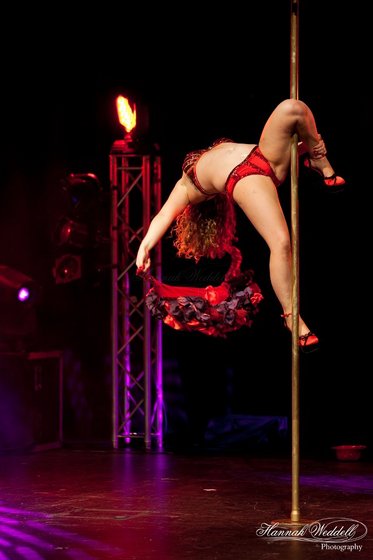
I'm another with hyperextended elbows. My right hyperextends a little bit and never causes me any problems. My left hyperextends much much more and it frequently annoys me.
It can be quite unstable to support me from below – if I hyperextend it it becomes painful but if I keep it neutral or slightly bent it becomes wobbly and unstable. So things like ayshas with my left hand down are much more difficult and scary than right hand down. And upright split grips with my left hand down would either hurt my elbow if it was hyperextended or my forearm if neutralfor over a year. So moves that require your student to support her weight from below may take more time to build up strength and become confident.
I have no problems hanging off my left arm. An arm with an unstable elbow is kind of like a rope. You can't stand a rope on it's end and balance a rock on it. But if you tie the rock to the rope and hang it from the ceiling the rope can take a lot of weight. (In this example the rock is my body and the rope is my arm).
As for aesthetics, when my arms are floating free I prefer to keep them neutral, not hyperextended. (I rarely suceed, but try anyway).I know ballet prefers neutral too. When I did gymnastics/diving/trampolining hyperextension was fine. I think it's all about what aesthetic you like and whether or not you care. Felix hyperextends her knees like crazy and it's just part of her style.
I don't have any strengthening exercises for your student, sorry, because I'm doing a one-person experiment where I try to build strength without any isolated exercises (working well for me so far, but not sure it would work for everyone). What I would say to your student is that people with hyperextended joints can sometimes be more prone to injuries, so listen to your body, watch out for pain, try to rest and change technique before it gets too bad, and just be patient with building strength. And always make sure to engage muscles!
-
very good comparison with the rope cinara!
it seems that it is very individual from person to person and also from trick to trick which arm position feels good and which not.
I really will try to make her sensible for this and tell her to listen to her body and let me know everything. I think this will be the most important part to allow her progressing fast and secure.
(besides the strenght exercises of course)
-
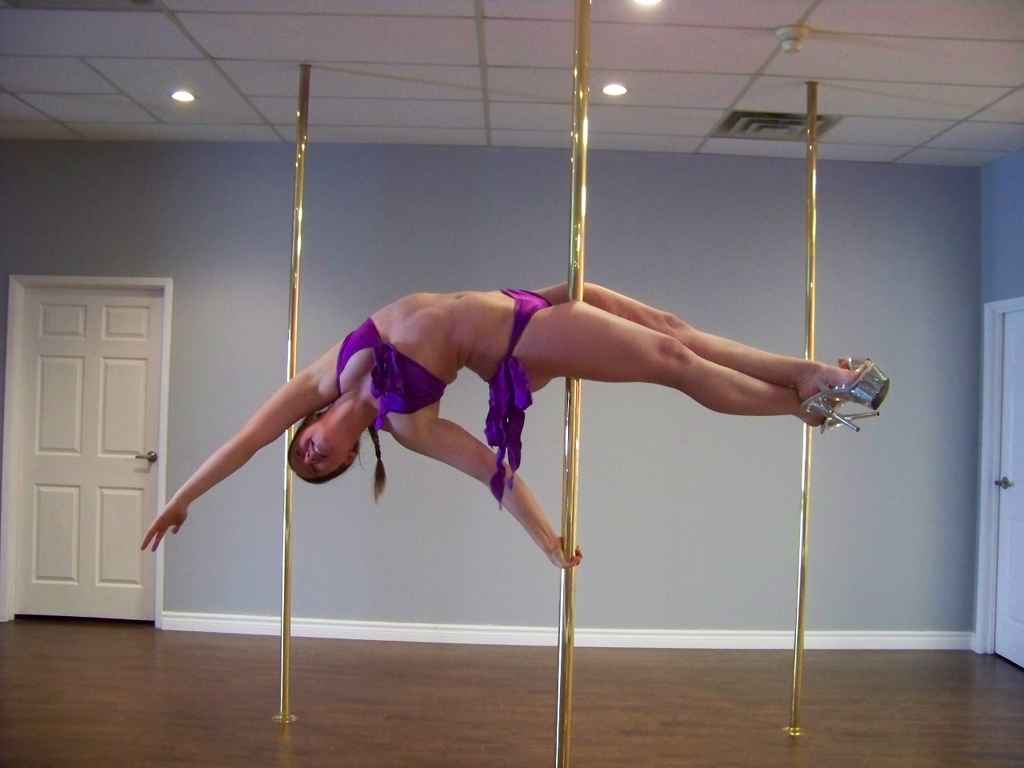
I have hyperextending elbows and knees too. My knees have caused me no end of grief because I tend to hold my weight (while standing) on my knee joints instead of the strong muscles in your legs. After nearly 30 years of this habit I have awful knees which also translates to sore feet, hips, and back sometimes. Yoga and pole have both really helped me break the habit and learn to use the muscles the way they are supposed to be used. I am stronger and have less pain than I used to because I try to be aware of my form. As for my elbows, while hyperextension feels "normal" for me it most definitely does not feel stronger or more secure while on the pole. My shoulders sink, and I lose all stability especially in inverted poses. It is something I have to constantly think about, but for me it is worth it to work on proper form.
-
does this mean you try to never hyperextend your knees or elbows dustbunny?
I think I also read that when you don´t break the habit, the joints can get really damaged and sometimes even a operation is neccessary (of course after a lot of years), but in some comment it sounds like some don´t get trouble from hyperextending their joints.
-
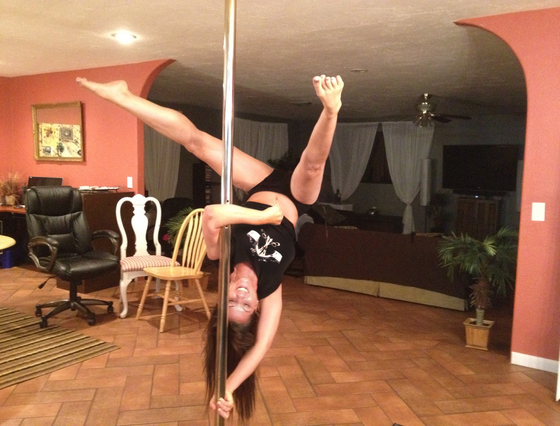
I recently have been made of aware of the hyperextended joints. If you're not experiencing any trouble, I would consider yourself lucky! You probably already do have some strength which might be protecting you. From my understanding it can lead to "tennis elbow" and can cause some real long term problems and pain for some. My gymnastics teacher just made me aware yesterday that my daughter is hyperextending and was very concerned. He immediately made her correct the position and explained although it was easier, she needed to be aware of the elbow lock and always to soften to prevent injury. Im sure w everything it varies form person to person but better to be safe- especially if you are teaching. I dont think it would be wise to allow someone to do something that could potantially injure themselves. Of course what they do on their own is up to them, but I really appreciated our gym instructor being concerned and offering a solution to prevent an injury. He also explained that it gives people a false sensse of security and strength as the lock is not coming from the muscle. Luckily she os only 8 and he said if she corrects it now, she wont develop that habit and save her joints in the future
-
that´s exactly what I thought first paulette. I don´t want her to injure anything of course while I teach her. It would be horrible for me if one of my students ever would get injured during my class!
That´s why I corrected her. I think I will ask her next time, if it´s okay for her if she won´t hyperextend her arms (at least during pole classes)
But what should I do if she doesn´t want to break the habit for pole dancing? I don´t want to stop teaching her of course, but I also don´t want to teach something I don´t stand behind…
And also important I don´t to force her to anything she doesn´t feel comfortable with.
On one side it´s her body of course and her decision what she expects of it, but on the other side I´m responsible for the health of my students during my class.
I´m really doubtful now….
it´s seems to be so individual, I think the only thing I can do is to decide together with her how to handle it. I really hope she will break the habit, so that there will be no risk to injure her arms. I think she´ll understand that I´m responsible for the health of my students during classes.
-
Well maybe you don't want to make it this complicated for a beginner student. What if you keep it really simple and explain it to her as "proper form" to keep the muscles engaged (just like the shoulder down thing)? As a beginner she's probably very nervous and has to think about so much while pole dancing that it doesn't really matter to her WHY you're telling her to do things a certain way.
And there's really no harm in letting her NOT hyperextend (when I see the answers in this thread the other way around we aren't that sure https://www.studioveena.com/img/smilies/icon_e_wink.gif ) especially in the beginning when she doesn't do any advanced tricks. And I think it's kinda easy to go from not hyperextending to hyperextending if one day she decides to change it.
Maybe later on you can talk to her about it in detail. If she asks and shows interest in the matter, then of course you should tell her what you know 🙂
(Are there even any beginner moves where you extend the arm completely and push with it? The first split grips in the carousel and boomerang spin are usually taught with a bent bottom arm …)
-
thanks RoseMay, that´s a great idea. I also recommend my other students to keep the arms slightly bend to make it easier to keep the arms engaged.
Seems to be a good and easy resolution for everyone.
It was her first pole class, so we didn´t do any split grips yet and it´ll need still a lot of time until we get there. I teach those when they can do some easy one-handed spins, so when we get to the split grip spins they can take of the pressure of the lower arm and wrist a bit while spinning.
I didn´t know that way to teach split grips, I´ll have to try that and see whether I´ll gonna teach it like this, too. For holds I teach it also with a bend bottom arm, because that´s a lot easier, but for spins I used the technic I described above where nearly no weight is on the lower arm.
-
I'm another hyper extension pole dancer. I never realized that my elbows hyper extended until this past year, when finally an instructor realized it. Since then I've looked at other people and realized how hyper extended I am. I have no problems with my hyper extension for any spins. Just like Cinara said my arm is like a rope. Hanging is no problem hyper extended. When I do an extended butterfly both arms are hyper extended and locked with no issue. If I do a catipillar climb or an Aysha I need to use the elbow grip rather than a split grip, but my bottom arm is hyper extended and locked. My only real issue is a stationary split grip where all the weight is in my arms. My top arm is fine but the bottom arm I need to bend to hold myself in place, otherwise my bottom wrist takes far too much weight. The most important thing is to be aware that a student with hyper extension will do things slightly differently and make sure they know enough to stop if something hurts. I think it fabulous that you are concerned about your student's hyper extension. Unfortunately there are a lot of pole instructors that do not have any real fitness background so they do not recognized hyper extension.
-
thanks for your replied. I had a private class with her and we talked about he. She said she never had pain because of her hyperextension, too. which is really good to here.
but I will keep all your tipps and experiences in mind, once we do our first split grips!
-

so glad you started this thread because everytime I have brought up this issue with pole friends/teachers, they look a mix of confused and scared. Then they tend to go 'oh' and gloss over it saying make sure I don't fully lock it out and if I do, do proper stretching (to which they don't tell me what to specifically do…) and it annoys me because I just want confirmation that I'm not damaging myself if I occassionally hyperextend whilst in moves (it doesn't hurt but I'm always seeking approval that I'm ok to keep hyperextending haha).
The main thing for me is floorwork and poses and trying to make it look graceful and aethetically pleasing…. and because most the time I'm programmed to automatically 'Point your feet! / straighten your arms!' etc. and I forget I'm grossing out people with my funny angled elbows so I had to learn a few different arm positions to make it look 'normal' hehe
-
I totally understand how annoying your experiences were. A teacher should always care about the health of her students. If a student would get injured in one of my classes it would be my fault and I would feel responsible (except if a student didn´t follow my instructions) and so shoulde every teacher feel in my opinion.
If your teacher is not experienced enough to handle your special elbows, he should be honest and let you know. This would be better than giving you unclear instrucitons.
It sometimes can be good to gross out people 😉 as long as it doesn´t injure you. But I think it´s good that your try to position your arms normal, so you´re on the safe side
Log in to reply.